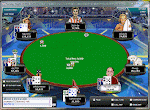
As I have watched my stats progress on officialpokerrankings.com, I have realized that I money between 40% and 50% of the time in every HORSE tournament I play. After a couple of months of observing this, it finally occured to me (genius that I am) that I ought to see if there are any larger HORSE tourneys available online (bigger buy-ins than the daily for $26...and hence, bigger pay outs.) I found that on Sundays Full Tilt runs a $200 buy-in HORSE. I have to admit...I was a little skittish. $26 to $200...that's a big jump. I decided to play two $10 satellites in the afternoon and see if I could win my way in. On the first one, I fell out rather early, but on the second I made it to 3rd place. The only problem? They only gave seats for the first 2 places. So I was stuck with a measley $24. I was so annoyed that I decided to enter the $200 event anyway.
Good thing I did. Even after my aces were cracked in Hold 'Em by A 4 off suit with two tables to go, I still ended up making the final table and finishing 6th. I was disappointed because by the time I made it that far I was obviously hoping to win and take home that beautiful prize that topped $10K, but all-in-all I really can't complain. My first "major" buy-in tourney online resulted in a final table cash. And I took home just under $1500 for my efforts. Not too shabby for a night spent on my couch in shorts and a t-shirt. (My lucky shirt actually. Which is not to say that it is lucky, only that it has a picture of the Lucky Charms lepruchan on it and it actually says "Lucky" on the front. So it is, by definition, my lucky shirt.)
It should also be mentioned that Fourth of July was fun. I met Chisum in Mesquite and we ripped up the 4-8 Omaha game. After we played for a few hours we went to eat at the steak house and catch the fireworks. As we were racking up (I tripled my buy-in and he doubled his), Chisum turned to me and said, "Look...no one can understand how the drunk donkeys are leaving with all the chips." I love playing drunk donkey! Especially in Omaha...so fun.
Until next time...may all your gambles pay off!
Sunday, July 6, 2008

Tuesday, June 24, 2008
Poker Chick...Who's That?
It's obviously been WAAAYYYY too long since I posted on this blog and I have no legitimate excuse for that. Life has been quite hectic, but that doesn't excuse the neglect to the poor blog. I've been doing a lot of real estate stuff lately (you can check that out at bluewaterdev.com), so poker has taken a back seat again, but I've still been playing online semi-regularly and I make it down to the tables every couple weeks or so.
The real story for me online has been the HORSE tourney on Full Tilt. I have worked my stats up to have an in the money average of 41% for that tourney. For those of you that don't know (and those of you that do can take this as a little brag) that's CRAZY good! A couple of weeks ago, I had back to back final table appearances and finished ninth, second, and fourth. I think I need to go scour the other sites and find some HORSE tourneys with higher buy ins. Maybe get into town once and a while and play some real life HORSE events.
As for casino play, my most recent venture was to Ceasar's. I met a couple of friends down there, Ben and Chisum, and Chisum and I took a piece of each other in the nightly tournament. For those of you that have never played the regular nightly tourneys at Ceasars they are quite good. The structure is decent and the starting chips vs. blinds is high enough that you aren't involved in a crap shoot. I got knocked out in the third round when I got it all in after the flop with QQ against another guy's under pair to the board - 99. I was eliminated when (you guessed it) a nine fell on the river...nice. Anyway, I headed out to the 1-3 live NL and made about $400 playing for the next three hours. During that time, Chisum made it to the final two tables and then helped orchestrate a 14 way chop for 1st. So I at least got my entry fee back out of it.
As always, playing in the casino provided me with some interesting encounters. A guy wearing a loud pin stripe suit, fedora, and gaudy fake jewelry sat down at my table and bought in for $300. He immediately began attempting to bully the table with ridiculous bluffs and lost his $300. When a seat opened up directly to his left, halfway through his second buy-in, I moved over next to him. He immediately began berating me, asking if I had come over because I thought he was a fish. I told him that I just liked the end seats at the table, but he wouldn't quit. He kept going on about how he'd been playing poker since before I was born and he didn't play TIGHT like me. On and on he went about how TIGHT I played. I didn't say anything. I only managed to get myself into two pots with him before he lost his third and final buy-in. On one of them I bluffed him off of his hand with two complete rags (which I didn't show because I was still hoping he'd stick around a while) and on the other I got him to call me down when I flopped two pair.
About half an hour after he had disgustedly left our table, I took a bathroom break and stopped to say hi to Ben who was at another game across the room. I came up laughing and started talking loudly, "Man you wouldn't believe this guy who was at our table a few minutes ago," I began, "sitting there trying to be all Gangster with his fake Versace suit and a toupee that looked like an animal died on his head." It was just like you see in the movies. Ben's eyes got really big while I was talking and then as soon as I came up for air he grabbed my hand and spoke in a low tone, "You mean that guy over there in the two seat?" "Oh no!" I thought. I peered around the dealer and, sure enough, there he was in the two. I couldn't help but laugh at myself. "Oooops," I said. I know he heard me. Everyone at the table must have. I felt bad. Well, not that bad. He had been a jerk. But I always figure that losing their money is enough of a punishment for jerks like that. I don't have to rub it in.
Until next time...remember to look both ways before you berate an absent player.
The real story for me online has been the HORSE tourney on Full Tilt. I have worked my stats up to have an in the money average of 41% for that tourney. For those of you that don't know (and those of you that do can take this as a little brag) that's CRAZY good! A couple of weeks ago, I had back to back final table appearances and finished ninth, second, and fourth. I think I need to go scour the other sites and find some HORSE tourneys with higher buy ins. Maybe get into town once and a while and play some real life HORSE events.
As for casino play, my most recent venture was to Ceasar's. I met a couple of friends down there, Ben and Chisum, and Chisum and I took a piece of each other in the nightly tournament. For those of you that have never played the regular nightly tourneys at Ceasars they are quite good. The structure is decent and the starting chips vs. blinds is high enough that you aren't involved in a crap shoot. I got knocked out in the third round when I got it all in after the flop with QQ against another guy's under pair to the board - 99. I was eliminated when (you guessed it) a nine fell on the river...nice. Anyway, I headed out to the 1-3 live NL and made about $400 playing for the next three hours. During that time, Chisum made it to the final two tables and then helped orchestrate a 14 way chop for 1st. So I at least got my entry fee back out of it.
As always, playing in the casino provided me with some interesting encounters. A guy wearing a loud pin stripe suit, fedora, and gaudy fake jewelry sat down at my table and bought in for $300. He immediately began attempting to bully the table with ridiculous bluffs and lost his $300. When a seat opened up directly to his left, halfway through his second buy-in, I moved over next to him. He immediately began berating me, asking if I had come over because I thought he was a fish. I told him that I just liked the end seats at the table, but he wouldn't quit. He kept going on about how he'd been playing poker since before I was born and he didn't play TIGHT like me. On and on he went about how TIGHT I played. I didn't say anything. I only managed to get myself into two pots with him before he lost his third and final buy-in. On one of them I bluffed him off of his hand with two complete rags (which I didn't show because I was still hoping he'd stick around a while) and on the other I got him to call me down when I flopped two pair.
About half an hour after he had disgustedly left our table, I took a bathroom break and stopped to say hi to Ben who was at another game across the room. I came up laughing and started talking loudly, "Man you wouldn't believe this guy who was at our table a few minutes ago," I began, "sitting there trying to be all Gangster with his fake Versace suit and a toupee that looked like an animal died on his head." It was just like you see in the movies. Ben's eyes got really big while I was talking and then as soon as I came up for air he grabbed my hand and spoke in a low tone, "You mean that guy over there in the two seat?" "Oh no!" I thought. I peered around the dealer and, sure enough, there he was in the two. I couldn't help but laugh at myself. "Oooops," I said. I know he heard me. Everyone at the table must have. I felt bad. Well, not that bad. He had been a jerk. But I always figure that losing their money is enough of a punishment for jerks like that. I don't have to rub it in.
Until next time...remember to look both ways before you berate an absent player.
Saturday, March 1, 2008
BricktopUS No Longer
Well, although I have been to Oklahoma City twice in the last three weeks, I haven't made it down to the casino yet. I will definitely have to make that a priority on my next trip and report back on the action.
I did, however, get online a few days after my 4th place finish in the $24K guarantee and took 8th place in the $14,500 guarantee 6 handed Hold 'Em tourney. That made for back-to-back top ten finishes in MTT play. Hooray!
After that last cash, I decided to withdraw some funds out of my Full Tilt account. I went through their silly verification process and then just as the check was supposed to be mailed, they decided to close my BricktopUS account. A while ago, I had created a second account for a friend of mine to use and that is apparently against Full Tilt policy (although I never played on the second account.) The frustrating thing was that Full Tilt didn't seem to have any interest what-so-ever in dealing with the two account situation UNTIL I tried to withdraw money from my BricktopUS account. Then they decided that they needed to shut down the Bricktop account and make my other account the primary account. They moved all of my funds from Bricktop to my new account, but now I have to go through their stupid verification process again in order to withdraw money from the account. I have heard other people complain that they have had trouble getting money OUT of Full Tilt. I really hope that this isn't a bad sign. If any of you out there have any experience in withdrawing funds from Full Tilt, good or bad, drop me a line and let me know. I'm curious to see if these sorts of delays are normal.
So the other downside to this operation is that I can no longer continue to improve my ranking on the Bricktop account. With my recent MTT finishes, I had worked my way up to the top 99% of Full Tilt players on officialpokerrankings.com Now I'll have to start all over with my other account. Oh well. At least I'll be a wolf in sheep's clothing for a while. For those who are interested, my new screen name is kartenkatze. I haven't played any MTTs on there as of yet, but hopefully I'll find time here in the next week or so.
Meanwhile, I just recently got back from a great ski trip to Tahoe. I was up there for four days and the whole trip was almost charmed. The weather was absolutely perfect...sunny and crisp, the snow held up fabulously and made for almost ideal conditions, and the company was wonderful. I had a really great time and have arrived back in Vegas refreshed and ready to conquer the world. I'll post a photo of me on the slopes.
Until next time...don't forget to take time away from the tables to enjoy all that this beautiful planet has to offer!
I did, however, get online a few days after my 4th place finish in the $24K guarantee and took 8th place in the $14,500 guarantee 6 handed Hold 'Em tourney. That made for back-to-back top ten finishes in MTT play. Hooray!
After that last cash, I decided to withdraw some funds out of my Full Tilt account. I went through their silly verification process and then just as the check was supposed to be mailed, they decided to close my BricktopUS account. A while ago, I had created a second account for a friend of mine to use and that is apparently against Full Tilt policy (although I never played on the second account.) The frustrating thing was that Full Tilt didn't seem to have any interest what-so-ever in dealing with the two account situation UNTIL I tried to withdraw money from my BricktopUS account. Then they decided that they needed to shut down the Bricktop account and make my other account the primary account. They moved all of my funds from Bricktop to my new account, but now I have to go through their stupid verification process again in order to withdraw money from the account. I have heard other people complain that they have had trouble getting money OUT of Full Tilt. I really hope that this isn't a bad sign. If any of you out there have any experience in withdrawing funds from Full Tilt, good or bad, drop me a line and let me know. I'm curious to see if these sorts of delays are normal.
So the other downside to this operation is that I can no longer continue to improve my ranking on the Bricktop account. With my recent MTT finishes, I had worked my way up to the top 99% of Full Tilt players on officialpokerrankings.com Now I'll have to start all over with my other account. Oh well. At least I'll be a wolf in sheep's clothing for a while. For those who are interested, my new screen name is kartenkatze. I haven't played any MTTs on there as of yet, but hopefully I'll find time here in the next week or so.
Meanwhile, I just recently got back from a great ski trip to Tahoe. I was up there for four days and the whole trip was almost charmed. The weather was absolutely perfect...sunny and crisp, the snow held up fabulously and made for almost ideal conditions, and the company was wonderful. I had a really great time and have arrived back in Vegas refreshed and ready to conquer the world. I'll post a photo of me on the slopes.
Until next time...don't forget to take time away from the tables to enjoy all that this beautiful planet has to offer!
Sunday, February 17, 2008
Away From the Tables
Funny how sometimes, without even closing a door, the Universe will open a window. By keeping ourselves open to the amazing opportunities that surround us every day, we can sometimes stumble into experiences and relationships that change our lives. Two weeks ago, I was a hard working poker player, enjoying my freedom but struggling under the pressure of relying on a game to make a living. I have found that the times when I have enjoyed poker the most, have been the times that I was doing something else to earn money at the same time. There's something comforting about not HAVING to play every day. I enjoy it more when I do play, and I seem to play better as well.
So I had been thinking lately about getting involved in another real estate venture. I love real estate almost as much as I do poker. I came up with an idea involving purchsing REOs and rehabbing them for rent here in the Vegas market. I was still just in the "thinking stage" of things when, to make a fairly long story short, a couple of weeks ago, I met Howie. We met in a social setting and started talking real estate. Within a few days we realized that we wanted to work together. A few days after that, we realized that we work really well together. And less than two weeks after first meeting we had a signed contract for work in Oklahoma City. Seems that the hard money lender that I had approached to fund my REO deal, had a group of houses in Oklahoma City that he had foreclosed on in various stages of disrepair. I pitched him the idea of allowing us to rehab his properties and then help him sell them for a profit instead of taking a loss on the project. He agreed. Amazing how things can change in such a short time.
So with my new time commitments to the Oklahoma project, I haven't had much time in the last couple weeks for poker. And I miss it a lot. I really wanted to go play tonight, but I was so tired from the week that I decided to just stay home and play a few MTTs online. I only entered three events...the $4K guarantee HORSE, the $11K 6 handed NL Hold 'Em, and the $24K guarantee NL Hold 'Em...all on Full Tilt.
I was super thrilled when I ended up taking 4th out of over 1500 entrants in the $24K. I collected over $2300 for my efforts. The final hand was a heartbreaker. I woke up with AKs in the BB. UTG raised and the button shoved all in. The button had me just barely covered. I actually thought about it briefly, but it is almost impossible to fold AKs at a four handed final table. I called. UTG mucked and the button turned over AQ. I was stoked. If I won the hand and doubled up, I would be chip leader by a fairly sizable margin with essentially three players left. When the queen came off on the turn, I felt a wave of disappointment. So close to having a great chance at winning the whole thing. I got over the frustration quickly though and decided to focus on the positive. I have a great new "job" that I'm working on, and in my first night playing in the last two weeks, I took fourth in a large tourney and made over $2K...not bad, not bad at all.
Of course, one of my tasks in Oklahoma City will be to locate that casino that Scotty Nguyen represents. I haven't played poker in Oklahoma yet...I'm looking forward to adding that notch to my belt. I'll keep you posted.
So I had been thinking lately about getting involved in another real estate venture. I love real estate almost as much as I do poker. I came up with an idea involving purchsing REOs and rehabbing them for rent here in the Vegas market. I was still just in the "thinking stage" of things when, to make a fairly long story short, a couple of weeks ago, I met Howie. We met in a social setting and started talking real estate. Within a few days we realized that we wanted to work together. A few days after that, we realized that we work really well together. And less than two weeks after first meeting we had a signed contract for work in Oklahoma City. Seems that the hard money lender that I had approached to fund my REO deal, had a group of houses in Oklahoma City that he had foreclosed on in various stages of disrepair. I pitched him the idea of allowing us to rehab his properties and then help him sell them for a profit instead of taking a loss on the project. He agreed. Amazing how things can change in such a short time.
So with my new time commitments to the Oklahoma project, I haven't had much time in the last couple weeks for poker. And I miss it a lot. I really wanted to go play tonight, but I was so tired from the week that I decided to just stay home and play a few MTTs online. I only entered three events...the $4K guarantee HORSE, the $11K 6 handed NL Hold 'Em, and the $24K guarantee NL Hold 'Em...all on Full Tilt.
I was super thrilled when I ended up taking 4th out of over 1500 entrants in the $24K. I collected over $2300 for my efforts. The final hand was a heartbreaker. I woke up with AKs in the BB. UTG raised and the button shoved all in. The button had me just barely covered. I actually thought about it briefly, but it is almost impossible to fold AKs at a four handed final table. I called. UTG mucked and the button turned over AQ. I was stoked. If I won the hand and doubled up, I would be chip leader by a fairly sizable margin with essentially three players left. When the queen came off on the turn, I felt a wave of disappointment. So close to having a great chance at winning the whole thing. I got over the frustration quickly though and decided to focus on the positive. I have a great new "job" that I'm working on, and in my first night playing in the last two weeks, I took fourth in a large tourney and made over $2K...not bad, not bad at all.
Of course, one of my tasks in Oklahoma City will be to locate that casino that Scotty Nguyen represents. I haven't played poker in Oklahoma yet...I'm looking forward to adding that notch to my belt. I'll keep you posted.
Thursday, January 24, 2008
Poker Books Part 2
Today we continue with Happy Donkey's list of worthy poker reading material:
2. Harrington on Hold ‘Em by Dan Harrington and Bill Robertie
Until the Full Tilt Strategy Guide came out, this three volume set was the authority on tournament play. Dan Harrington is a renowned tournament player with many accolades. He has won major tournaments as recently as last year. Dan has done a great job of writing a piece that helps players develop their entire strategy from the ground up.
The series is divided into three volumes. Volumes One and Two are essentially one book split in two. Volume Three is a workbook that allows for more hand analysis and is the least critical of the three to read. Online, the books are frequently referred to as HoH.
Early tournament play is very different from play during “the bubble” (the time just before everyone ends up in the money), and short handed and heads up play is very different from the first two stages. Volume One (V1) deals primarily with the earlier stages of the tournament. V1 introduces you to Dan’s main method of conveying information: detailed hand analysis. Experienced tournament players might not find V1 as compelling as newbies, but it contains several concepts that merit the time taken to read it. {Tamara: I agree with this analysis. I found V1 fairly slow and felt that I had a pretty good grasp on most of the concepts conveyed before I read the book. There are good little tidbits scattered throughout though, so I'm still glad that I took the time to wade through it.}
Where HoH earns its money, however, is V2. V2 contains what is arguably the single most important concept in tournament play: “M.” M (which stands for Magriel, the last name of a famous backgammon author who developed the concept) is equivalent to the total of the small blind, big blind, and antes for one orbit, basically the total amount that it costs you to see on orbit of hands. Once you calculate how many M your stack is, (as well as what your opponent’s stacks are) you can develop your entire tournament strategy around this information. (Many online tournament players consider stack size in relation to the number of BBs, or Big Blinds, instead of M. While M is a more accurate method, BB is an easier method. Serious poker players should understand the benefits of and be conversant with both methods.) To be clear: if you don’t understand this concept, you will have your butt handed to you on a regular basis. {It is fascinating to me how many people play in tournaments semi-regularly and do not understand how to take M into account when making important decisions. If you play in tourneys and do not have an in depth understanding of M, the red zone, and other issues surrounding stack dynamics, then you need to educate yourself as soon as possible.}
V2 also discusses short handed and heads up play, something that some cash (ring) game players {especially those who play low or mid limits} are unfamiliar with. Once again, the main format is detailed hand analysis based on real tournament hands.
While natural talent and extensive experience will carry a tournament player a long way, HoH is one of the most critical set of books available today.
3. Card Player magazine
If you play poker in a card room, you’re probably familiar with Card Player magazine. It’s free, it’s well put together, and many pass time reading them during lulls in action at the table (when they really should be observing their opponents.) Many poker players seem to take this publication for granted, and they really don’t know what they are missing. Barry and Jeff Schulman have put together a very well organized magazine that provides information on many different aspects of the game.
Aside from the dozens of features and sections that you would expect to find in a poker oriented trade magazine, there are numerous regular columns that help hone your game. The regular contributors are highly regarded poker players, some selected for their writing and educational skills (David Aposolico, Barry Tannenbaum, Bob Ciaffone), some for their marquis names (Daniel Negraneau, Todd Brunson, Phil Hellmuth). Craig Tapscott does a great job of interviewing players and getting inside their heads on specific hands that they’ve played. Aside from the online forums, this bi-monthly publication is the most up to date method of obtaining information on current concepts and popular strategies that are being developed daily. {I agree wholeheartedly about the value of reading Card Player. Not only do the articles help develop aspects of your game, but they allow you to get inside the minds of your fellow players. Sometimes reading about how other players are approaching certain plays, will allow you to develop a strategy to counteract that style of play. In my opinion (and I think that this would be a great topic for a blog post all its own) poker styles move in cyclical waves...much like the economy. For a while, it was considered "correct" to play very tight, conservative poker. Loose aggressive players were regarded as donkeys or maniacs and very few serious pros took this approach to the game. Now loose aggressive play is regarded as the pinnacle of poker achievement. Being able to enter and "mix it up" in a large number of pots and still come out ahead is thought to be the hallmark of a great player. Understanding these tendencies within the poker playing community can help you to adjust your game to take maximum advantage of the trends. And Card Player helps you keep your finger on the pulse of that community. (Yeah, I definitely need to do a post on the changing face of poker...there is so much that could be said on that topic.)
If you can’t get enough current material there are a few other magazines out there that are very much worth reading. Poker Player News headed by Mike Caro and Bluff magazine both provide more information and different perspectives.
All of these magazines are available for free in the various casinos and card rooms. For those that don’t have easy access to these outlets, you can subscribe to them for a reasonable cost. Just google the publications and order them online.
4. The Tao of Poker by Larry Phillips
This is a great little book that helps you develop a solid, healthy approach to poker. While most other books are about specific concepts like selecting your starting hands or when you need to get into “push or fold” mode, this book helps you develop more of a mindset for the game. Everything needs balance, as does your education in poker.
For those that have studied the Tao, you might be surprised or even a bit disappointed at first that the book doesn’t seem to address the Tao more directly. But if you understand the Tao, read through the book, and then reflect back on the information, you find that it is very Taoist and does help you mold your game into a more fluid approach.
If you find that you explode easily, take bad beats harder than most, or wish that you did not let your emotions affect your game as much as it does, this would be a good read for you. {I found this book interesting but not indispensable. I would actually recommend it as a great addition to your bathroom library. Reading it all in one sitting makes it easy for you to gloss over the little tidbits of inspiration and wisdom. Reading a couple of pages each day would probably make for more effective and constructive absorption of the material.}
5. Honorable Mention: Super System
Props have to be given to Doyle Brunson for putting together Super System. Perhaps the most famous poker player ever, Doyle compiled the first book at a time when very few poker books existed. Doyle was very wise in assembling the best players at the time and getting them to extol their knowledge with the intent of educating newcomers and pros alike. Mike Craig unashamedly cites Super System as his model for The Full Tilt Strategy Guide, Tournament Edition. It is very likely that if polled, Super System would appear at the top of the list of first poker book read by new players. {Well if the new players started playing in the 90s or before (as I did) then that would probably be the case. Now days, I'm not sure how many new players are reading it...especially the first edition.} This is why Super System has been referred to as “the Bible of Poker.”
In Doyle’s heyday, tournaments were overshadowed by the cash (ring) game, and that is what this book focuses on. (After all, it was only a few years before Doyle wrote the book that the winner of the WSOP was established by popular vote!) The book provides new players with a solid foundation on how to play the cash NLH game as well as several other poker styles.
Why this book is not more essential, is because the material is dated. You can certainly gain a lot of information from Super System, but as you become more aggressive about honing your game, you realize more and more that poker is not only evolving, it is evolving rapidly. The strategies in this book are too tight and conservative to be effective. {I'm not so sure about that...I think that in a world increasingly dominated by loose aggressive players, the niche for tight conservative players is growing somewhat. More on this concept in a future post.} They’ll keep you out of trouble as you improve your game, but for the experienced player who is looking to maximize their educational bang, there are a lot of newer books that subscribe to the current school of thought that you need to be aggressive to win. To be fair, Doyle has subsequently compiled Super System 2, a good sequel enlisting more prominent, successful players to contribute. {I have not yet read Super System 2 but it is on my list of things to do.}
6. Honorable Mention: David Sklansky and Mason Malmuth
Prolific writers, Sklansky and Malmuth wrote most of the early books on poker. You cannot go wrong reading any of their books (published by 2+2 Publishing), although most of their information has been assimilated into the other more current publications. These authors forged the path for others to follow, and while they are a bit dry for the times, their content is still very valid and applicable. {Sklansky and Malmuth are the once and always kings of the mathematics behind the game. The first poker books that I read were written by these guys. I actually HIGHLY recommend getting your hands on at least one Sklansky/Malmuth book and digesting the material. Math plays an important role in poker and (in my opinion) before you can move on to the intricacies of psychological play and "people factors" you need to have a solid foundation in the probabilities and statistics that define the game. If you don't, your education will be lopsided and incomplete.}
One final recommendation is for those that have read the essential books and are looking for something different. Barry Greenstein’s Ace on the River is a great book for someone that is looking to take their poker game from being a money making hobby to being the centerpiece of their lifestyle. The beautiful book stays away from the technical side of a poker and focuses on some very important intangible concepts. These concepts include how high-stakes players interact with each other, strategy on keeping live players in the game, and a frank discussion of the downswings that all professional players inevitably go through. You will not learn how to pull off a triple barrel bluff in this book, but you might learn some life skills that will be necessary to survive if you aspire to be a professional poker player. {I LOVED Barry's book and if this were my list (and not Happy Donkey's) I would have placed it much closer to the top. There are plenty of great technical and "how to" poker books on the shelves today, but only one Ace on the River. Barry's discussion of life as a pro hit home with me. It was great to realize that I'm not the only one who has experienced the frustrations that sometimes accompany making your living at this game. Just knowing that successful pros have faced the same temptations and challenges (with varying degrees of success) makes me feel more hopeful that I will be able to work through them in my own life/game. If you play for a living...or want to someday...you must read this book.}
The list above is certainly not comprehensive nor exclusive. It does, however, provide you with a list of essential reading and you can feel confident that the books listed are a worthy investment of your time. Feel free to post your suggestions in reply!
2. Harrington on Hold ‘Em by Dan Harrington and Bill Robertie
Until the Full Tilt Strategy Guide came out, this three volume set was the authority on tournament play. Dan Harrington is a renowned tournament player with many accolades. He has won major tournaments as recently as last year. Dan has done a great job of writing a piece that helps players develop their entire strategy from the ground up.
The series is divided into three volumes. Volumes One and Two are essentially one book split in two. Volume Three is a workbook that allows for more hand analysis and is the least critical of the three to read. Online, the books are frequently referred to as HoH.
Early tournament play is very different from play during “the bubble” (the time just before everyone ends up in the money), and short handed and heads up play is very different from the first two stages. Volume One (V1) deals primarily with the earlier stages of the tournament. V1 introduces you to Dan’s main method of conveying information: detailed hand analysis. Experienced tournament players might not find V1 as compelling as newbies, but it contains several concepts that merit the time taken to read it. {Tamara: I agree with this analysis. I found V1 fairly slow and felt that I had a pretty good grasp on most of the concepts conveyed before I read the book. There are good little tidbits scattered throughout though, so I'm still glad that I took the time to wade through it.}
Where HoH earns its money, however, is V2. V2 contains what is arguably the single most important concept in tournament play: “M.” M (which stands for Magriel, the last name of a famous backgammon author who developed the concept) is equivalent to the total of the small blind, big blind, and antes for one orbit, basically the total amount that it costs you to see on orbit of hands. Once you calculate how many M your stack is, (as well as what your opponent’s stacks are) you can develop your entire tournament strategy around this information. (Many online tournament players consider stack size in relation to the number of BBs, or Big Blinds, instead of M. While M is a more accurate method, BB is an easier method. Serious poker players should understand the benefits of and be conversant with both methods.) To be clear: if you don’t understand this concept, you will have your butt handed to you on a regular basis. {It is fascinating to me how many people play in tournaments semi-regularly and do not understand how to take M into account when making important decisions. If you play in tourneys and do not have an in depth understanding of M, the red zone, and other issues surrounding stack dynamics, then you need to educate yourself as soon as possible.}
V2 also discusses short handed and heads up play, something that some cash (ring) game players {especially those who play low or mid limits} are unfamiliar with. Once again, the main format is detailed hand analysis based on real tournament hands.
While natural talent and extensive experience will carry a tournament player a long way, HoH is one of the most critical set of books available today.
3. Card Player magazine
If you play poker in a card room, you’re probably familiar with Card Player magazine. It’s free, it’s well put together, and many pass time reading them during lulls in action at the table (when they really should be observing their opponents.) Many poker players seem to take this publication for granted, and they really don’t know what they are missing. Barry and Jeff Schulman have put together a very well organized magazine that provides information on many different aspects of the game.
Aside from the dozens of features and sections that you would expect to find in a poker oriented trade magazine, there are numerous regular columns that help hone your game. The regular contributors are highly regarded poker players, some selected for their writing and educational skills (David Aposolico, Barry Tannenbaum, Bob Ciaffone), some for their marquis names (Daniel Negraneau, Todd Brunson, Phil Hellmuth). Craig Tapscott does a great job of interviewing players and getting inside their heads on specific hands that they’ve played. Aside from the online forums, this bi-monthly publication is the most up to date method of obtaining information on current concepts and popular strategies that are being developed daily. {I agree wholeheartedly about the value of reading Card Player. Not only do the articles help develop aspects of your game, but they allow you to get inside the minds of your fellow players. Sometimes reading about how other players are approaching certain plays, will allow you to develop a strategy to counteract that style of play. In my opinion (and I think that this would be a great topic for a blog post all its own) poker styles move in cyclical waves...much like the economy. For a while, it was considered "correct" to play very tight, conservative poker. Loose aggressive players were regarded as donkeys or maniacs and very few serious pros took this approach to the game. Now loose aggressive play is regarded as the pinnacle of poker achievement. Being able to enter and "mix it up" in a large number of pots and still come out ahead is thought to be the hallmark of a great player. Understanding these tendencies within the poker playing community can help you to adjust your game to take maximum advantage of the trends. And Card Player helps you keep your finger on the pulse of that community. (Yeah, I definitely need to do a post on the changing face of poker...there is so much that could be said on that topic.)
If you can’t get enough current material there are a few other magazines out there that are very much worth reading. Poker Player News headed by Mike Caro and Bluff magazine both provide more information and different perspectives.
All of these magazines are available for free in the various casinos and card rooms. For those that don’t have easy access to these outlets, you can subscribe to them for a reasonable cost. Just google the publications and order them online.
4. The Tao of Poker by Larry Phillips
This is a great little book that helps you develop a solid, healthy approach to poker. While most other books are about specific concepts like selecting your starting hands or when you need to get into “push or fold” mode, this book helps you develop more of a mindset for the game. Everything needs balance, as does your education in poker.
For those that have studied the Tao, you might be surprised or even a bit disappointed at first that the book doesn’t seem to address the Tao more directly. But if you understand the Tao, read through the book, and then reflect back on the information, you find that it is very Taoist and does help you mold your game into a more fluid approach.
If you find that you explode easily, take bad beats harder than most, or wish that you did not let your emotions affect your game as much as it does, this would be a good read for you. {I found this book interesting but not indispensable. I would actually recommend it as a great addition to your bathroom library. Reading it all in one sitting makes it easy for you to gloss over the little tidbits of inspiration and wisdom. Reading a couple of pages each day would probably make for more effective and constructive absorption of the material.}
5. Honorable Mention: Super System
Props have to be given to Doyle Brunson for putting together Super System. Perhaps the most famous poker player ever, Doyle compiled the first book at a time when very few poker books existed. Doyle was very wise in assembling the best players at the time and getting them to extol their knowledge with the intent of educating newcomers and pros alike. Mike Craig unashamedly cites Super System as his model for The Full Tilt Strategy Guide, Tournament Edition. It is very likely that if polled, Super System would appear at the top of the list of first poker book read by new players. {Well if the new players started playing in the 90s or before (as I did) then that would probably be the case. Now days, I'm not sure how many new players are reading it...especially the first edition.} This is why Super System has been referred to as “the Bible of Poker.”
In Doyle’s heyday, tournaments were overshadowed by the cash (ring) game, and that is what this book focuses on. (After all, it was only a few years before Doyle wrote the book that the winner of the WSOP was established by popular vote!) The book provides new players with a solid foundation on how to play the cash NLH game as well as several other poker styles.
Why this book is not more essential, is because the material is dated. You can certainly gain a lot of information from Super System, but as you become more aggressive about honing your game, you realize more and more that poker is not only evolving, it is evolving rapidly. The strategies in this book are too tight and conservative to be effective. {I'm not so sure about that...I think that in a world increasingly dominated by loose aggressive players, the niche for tight conservative players is growing somewhat. More on this concept in a future post.} They’ll keep you out of trouble as you improve your game, but for the experienced player who is looking to maximize their educational bang, there are a lot of newer books that subscribe to the current school of thought that you need to be aggressive to win. To be fair, Doyle has subsequently compiled Super System 2, a good sequel enlisting more prominent, successful players to contribute. {I have not yet read Super System 2 but it is on my list of things to do.}
6. Honorable Mention: David Sklansky and Mason Malmuth
Prolific writers, Sklansky and Malmuth wrote most of the early books on poker. You cannot go wrong reading any of their books (published by 2+2 Publishing), although most of their information has been assimilated into the other more current publications. These authors forged the path for others to follow, and while they are a bit dry for the times, their content is still very valid and applicable. {Sklansky and Malmuth are the once and always kings of the mathematics behind the game. The first poker books that I read were written by these guys. I actually HIGHLY recommend getting your hands on at least one Sklansky/Malmuth book and digesting the material. Math plays an important role in poker and (in my opinion) before you can move on to the intricacies of psychological play and "people factors" you need to have a solid foundation in the probabilities and statistics that define the game. If you don't, your education will be lopsided and incomplete.}
One final recommendation is for those that have read the essential books and are looking for something different. Barry Greenstein’s Ace on the River is a great book for someone that is looking to take their poker game from being a money making hobby to being the centerpiece of their lifestyle. The beautiful book stays away from the technical side of a poker and focuses on some very important intangible concepts. These concepts include how high-stakes players interact with each other, strategy on keeping live players in the game, and a frank discussion of the downswings that all professional players inevitably go through. You will not learn how to pull off a triple barrel bluff in this book, but you might learn some life skills that will be necessary to survive if you aspire to be a professional poker player. {I LOVED Barry's book and if this were my list (and not Happy Donkey's) I would have placed it much closer to the top. There are plenty of great technical and "how to" poker books on the shelves today, but only one Ace on the River. Barry's discussion of life as a pro hit home with me. It was great to realize that I'm not the only one who has experienced the frustrations that sometimes accompany making your living at this game. Just knowing that successful pros have faced the same temptations and challenges (with varying degrees of success) makes me feel more hopeful that I will be able to work through them in my own life/game. If you play for a living...or want to someday...you must read this book.}
The list above is certainly not comprehensive nor exclusive. It does, however, provide you with a list of essential reading and you can feel confident that the books listed are a worthy investment of your time. Feel free to post your suggestions in reply!
Monday, January 21, 2008
Poker Books Part 1
In various conversations with poker buddies as well as emails that I have received recently, the subject of poker books has come up quite frequently. Several people have asked me if I read these books and which ones I recommend. The answer is that I absolutely do read poker related material: books, articles, other blogs and forums. I think that this type of ongoing education is critical to the success of anyone even remotely serious about the game. In light of the recent questions and comments, Happy Donkey decided to put together a list of some of our favorite poker related books. I am going to post his contribution in two separate blog entries. Here is Part 1 from Happy Donkey:
"If you are not aware that poker is a rapidly evolving game, then you are not paying enough attention and will likely be outplayed tomorrow by players who are less skillful than you are today. This is especially true when it comes to No Limit Texas Hold ‘Em (NLH), currently the most popular form of the game. That said, anyone who believes that they are taking poker seriously, is kidding themselves if they are not reading about it regularly. There is just so much information being generated on a daily basis, that if you ignore it, you will get left behind. If you are trying to improve your game, you need to develop a system for assimilating this information. One of the easiest ways to start out is to visit and participate in one of the myriad online forums. Not only is this a great interactive way to learn the new strategies and techniques that are being tested and developed, but it’s clearly the most current information available. Post a question, hand history, or theory on a forum and you could have multiple replies within hours. There are a lot of forums out there to choose from: Every online poker site has a forum, as does Card Player magazine’s website. (http://forums.cardplayer.com/forums/ ) Two other good forums are the 2+2 forum http://forumserver.twoplustwo.com/ and http://www.cardschat.com/ .
While getting your information online is a great tactical way to work on certain elements of your game, there are many good books out there to help you develop your major strategic concepts. A good book will have been organized to provide you with a systematic method to building your strategy from the ground up. This structure is especially important when new to the game. (Realize that when expanding your game from live cash (ring) games into tournament play or vice versa, you should look at it as being new to the game.) {Tamara: I can attest to the truth of this statement. As you all know, I have been moving from being almost exclusively a cash player to participating in MTTs online, and I can tell you that it is like trying to learn how to swim all over again. MTTs are COMPLETELY different from cash games and the first thing I did was to start reading as much good stuff as I could on tournament play.} As the list of books that have been written rapidly grows, it might be hard to determine which books you should read. After all, reading these books will require a reasonable time commitment, so you want to be sure to select the best books to give you the best return on your time. With that in mind, we have compiled a list of essential books that we think you shouldn't miss:
1. The Full Tilt Poker Strategy Guide, Tournament Edition by Michael Craig
Whether you are just starting out playing tournaments, or you consider yourself a tournament specialist, this is the most important book to read. Michael Craig has compiled a book with each section written by some of the best players on the circuit today, and the information they convey is critical to playing competitively in tournaments. It is no exaggeration to say that not understanding the information in this book and playing tournaments anyway is like being at the controls of an airplane without having a pilot’s license. {And Happy Donkey would know about that pilot thing!} Chris Ferguson’s explanations, especially with regard to post-flop play, are perhaps the most valuable contribution to the book. Andy Bloch’s section on pre-flop play and how to value starting hands is a crucial concept that every tournament player needs to have down. Also, do not deceive yourself into skipping the chapters that don’t have to do with NLH, because NLH is, after all, poker, and the information in the other chapters will help you understand important concepts that pertain to all forms of poker. {Omaha players will tell you that their Hold 'Em game has often benefited greatly by the application of pot building concepts that they learned from PLO. Other poker games can often help you see your Hold 'Em game in a new light. Plus if you want to be a well rounded player, you should really know how to proficiently play all poker games.} Phil Gordon says in the forward that people ask them why they are giving away their secrets, why they are writing a playbook for their opponents to beat them. He replies that they have made enough money, it is now about being the best and seeking out the best opponents and beating them. {For the record, I don't buy this philanthropic crap. I think that they wrote the book to gain exposure, which boosts their sponsorship appeal, which is where the big money is in poker today. But if it gives you warm fuzzies to think that Phil Gordon really wants you to be the best that you can be, then by all means go ahead and think that.} After reading this book it is clear that they are truly attempting to educate the poker world to elevate the level of play across the board. If you are to read one book about poker, this is the book. {I completely agree with that statement. The Full Tilt Guide is hands down the best poker book I have ever read. In fact, I should really re-read it. In fact, I think I'll go do that now.}"
I will post the rest of the list in the next blog entry.
Until next time...go read the book...what are you waiting for? Go now!
"If you are not aware that poker is a rapidly evolving game, then you are not paying enough attention and will likely be outplayed tomorrow by players who are less skillful than you are today. This is especially true when it comes to No Limit Texas Hold ‘Em (NLH), currently the most popular form of the game. That said, anyone who believes that they are taking poker seriously, is kidding themselves if they are not reading about it regularly. There is just so much information being generated on a daily basis, that if you ignore it, you will get left behind. If you are trying to improve your game, you need to develop a system for assimilating this information. One of the easiest ways to start out is to visit and participate in one of the myriad online forums. Not only is this a great interactive way to learn the new strategies and techniques that are being tested and developed, but it’s clearly the most current information available. Post a question, hand history, or theory on a forum and you could have multiple replies within hours. There are a lot of forums out there to choose from: Every online poker site has a forum, as does Card Player magazine’s website. (http://forums.cardplayer.com/forums/ ) Two other good forums are the 2+2 forum http://forumserver.twoplustwo.com/ and http://www.cardschat.com/ .
While getting your information online is a great tactical way to work on certain elements of your game, there are many good books out there to help you develop your major strategic concepts. A good book will have been organized to provide you with a systematic method to building your strategy from the ground up. This structure is especially important when new to the game. (Realize that when expanding your game from live cash (ring) games into tournament play or vice versa, you should look at it as being new to the game.) {Tamara: I can attest to the truth of this statement. As you all know, I have been moving from being almost exclusively a cash player to participating in MTTs online, and I can tell you that it is like trying to learn how to swim all over again. MTTs are COMPLETELY different from cash games and the first thing I did was to start reading as much good stuff as I could on tournament play.} As the list of books that have been written rapidly grows, it might be hard to determine which books you should read. After all, reading these books will require a reasonable time commitment, so you want to be sure to select the best books to give you the best return on your time. With that in mind, we have compiled a list of essential books that we think you shouldn't miss:
1. The Full Tilt Poker Strategy Guide, Tournament Edition by Michael Craig
Whether you are just starting out playing tournaments, or you consider yourself a tournament specialist, this is the most important book to read. Michael Craig has compiled a book with each section written by some of the best players on the circuit today, and the information they convey is critical to playing competitively in tournaments. It is no exaggeration to say that not understanding the information in this book and playing tournaments anyway is like being at the controls of an airplane without having a pilot’s license. {And Happy Donkey would know about that pilot thing!} Chris Ferguson’s explanations, especially with regard to post-flop play, are perhaps the most valuable contribution to the book. Andy Bloch’s section on pre-flop play and how to value starting hands is a crucial concept that every tournament player needs to have down. Also, do not deceive yourself into skipping the chapters that don’t have to do with NLH, because NLH is, after all, poker, and the information in the other chapters will help you understand important concepts that pertain to all forms of poker. {Omaha players will tell you that their Hold 'Em game has often benefited greatly by the application of pot building concepts that they learned from PLO. Other poker games can often help you see your Hold 'Em game in a new light. Plus if you want to be a well rounded player, you should really know how to proficiently play all poker games.} Phil Gordon says in the forward that people ask them why they are giving away their secrets, why they are writing a playbook for their opponents to beat them. He replies that they have made enough money, it is now about being the best and seeking out the best opponents and beating them. {For the record, I don't buy this philanthropic crap. I think that they wrote the book to gain exposure, which boosts their sponsorship appeal, which is where the big money is in poker today. But if it gives you warm fuzzies to think that Phil Gordon really wants you to be the best that you can be, then by all means go ahead and think that.} After reading this book it is clear that they are truly attempting to educate the poker world to elevate the level of play across the board. If you are to read one book about poker, this is the book. {I completely agree with that statement. The Full Tilt Guide is hands down the best poker book I have ever read. In fact, I should really re-read it. In fact, I think I'll go do that now.}"
I will post the rest of the list in the next blog entry.
Until next time...go read the book...what are you waiting for? Go now!
Sunday, January 20, 2008
The Bucket List
I went this evening to see "The Bucket List." If you're looking for a fast paced movie that will make you either laugh or sit tensely on the edge of your seat, then I wouldn't pick this one, but if you want to see something that will make you think, and cry a little, and feel just a little more grateful to be alive than when you went in, then I'd definitely check it out. The movie centers around two men who discover on the same day that they have terminal cancer and only months to live. They embark on a mission to experience life in a way that they never have before they die.
As I was watching, I couldn't help but wonder how many people on this planet will come anywhere close to crossing off all the things on their list before they die. Even sadder, how many people don't have a "bucket list" at all? How many people just sort of float through this life without bothering to consider what it is that they really hope to accomplish or experience before they leave this world?
I decided that I need to write my own bucket list. Maybe it's something everyone should do. I'm going to start mine and post it on the blog, where I can add to it as things come to mind. I encourage anyone else who reads this to consider starting a list of their own. We owe ourselves that much in life don't we?
Until next time...call someone you love and remind them that you're happy they're in your life!
As I was watching, I couldn't help but wonder how many people on this planet will come anywhere close to crossing off all the things on their list before they die. Even sadder, how many people don't have a "bucket list" at all? How many people just sort of float through this life without bothering to consider what it is that they really hope to accomplish or experience before they leave this world?
I decided that I need to write my own bucket list. Maybe it's something everyone should do. I'm going to start mine and post it on the blog, where I can add to it as things come to mind. I encourage anyone else who reads this to consider starting a list of their own. We owe ourselves that much in life don't we?
Until next time...call someone you love and remind them that you're happy they're in your life!
Thursday, January 17, 2008
Game/Table Selection
A couple of days ago, I enjoyed a great dinner at a new restaurant in town: Koi at Planet Hollywood. They offer Japanese fusion cuisine and, while the portions are a bit small for the price, the quality is excellent. I sampled a smoked salmon tartar with avocado and rice crackers that was to die for! Also, they offer a variety of interesting fru fru drinks, including some creative martini and cosmo concoctions that appealed to my love for "chick drinks." After dinner, and some cocktails with friends in the new media lounge (surrounded by Karaoke singers whose enthusiasm exceeded their talent), I headed over to the poker room to see what was shaking.
At one point Planet Hollywood was one of my most frequented late night Hold Em hot spots. But when I separated from my ex last year we split poker rooms like some couples split friends or pets or children. Truthfully, I was a little scared to go back. I had heard that some nasty rumors had been spread. But here I was, yards from one of my favorite places to play and accompanied by a handsome, poker-playing date, so I thought, "Why not? Now or never." I'm super glad that I did.
Not only did I get to see lots of people that I'd missed, but everyone was really nice and told me that I'd better come back more often. There was absolutely no awkwardness at all, in fact one dealer mentioned that I was always the "better half" of that equation anyway.
Also, returning to a game that had always been profitable for me reminded me how important table and game selection can be. It is tempting sometimes to fall into the trap of listening to other players describe a "juicy" game and assuming that the game they describe will be good for us as well. The fact is that different players play well at different types of games. A game that is perfect for Devo's hyper-aggressive style, would be WAY too loose and wild for someone with a more conservative style like Bear. A small stakes table with a bunch of drunk college kids and complete amateurs looks like heaven for Happy Donkey, because he is still at the stage where his bluffs are relatively simple and his play is somewhat straight forward, for me, however, that type of game is almost as painful as gouging my eyes out with a pencil.
As I played at Planet Hollywood, I remembered that the reason I loved to play there so much, wasn't just because the dealers are fun, the floor has half a clue what they're doing, and there aren't too many locals hanging around, it's also because the game is almost PERFECT for me. A tight, conservative game, with lots of calling stations who tend to play relatively straight up so I always know where they are at...sounds like heaven to me!
My point in all of this is that in order to maximize your profit potential, especially in live play, you need to first identify what style of poker you tend to play. This goes beyond classifying yourself as Loose Aggressive, or Tight Aggressive, or whatever. You need to honestly evaluate not only your over-all mode of play, but also your level of play. How sophisticated are your bluffs? Do you regularly attempt two barrel or three barrel bluffs? Do you check raise your draws? Or do you pretty much bet it when you've got it? How many flops do you like to see? Do you prefer to enter every pot with a raise or limp in a lot? Do you prefer to play deep stack poker or short stack poker?
Once you identify these tendencies within your own game, you can then look for the type of game that best suits your play. For example: If you are very patient, content to wait for premium hands and then play them aggressively for big pots, then you would probably do well in a relatively loose game where players don't mind giving action and you are more likely to get paid off. On the other hand, if you like to be the bully at the table, play lots of pots, and bluff people off of their hands, then a tighter, more conservative game might be more your style. If you are good at making sophisticated bluffs and giving people really good reasons to believe you, then you need to play in a game where the other players have a sufficient skill level to be able to respect your bluffs, and the game should also be deep stack so that you have enough leverage to execute. On the other hand, if you like to play straight up poker, then you can get away with smaller buy ins and more casual players.
Identifying what type of game works best for you is only the first part of the puzzle. After that, you have to locate your ideal games. Shop around. Play in different casinos, at different times, and for different stakes. And, of course, keep track of your wins and losses RELIGIOUSLY using a spreadsheet that allows you to enter the dates, times, lengths, and wins/losses of each session.
BTW...Happy Donkey is in the final stages of developing a KICK ASS spreadsheet for tracking live and online play complete with graphs, averages, and more data manipulation than any tracking program I have ever seen. It's taken him FOREVER to put it together, but I can't wait to share it with everyone as soon as it's done. Trust me...you'll wonder how you ever got along without it.
Until next time...remember, it's better to be a shark in a small pond then a fish in a big one!
Happy Hunting!
At one point Planet Hollywood was one of my most frequented late night Hold Em hot spots. But when I separated from my ex last year we split poker rooms like some couples split friends or pets or children. Truthfully, I was a little scared to go back. I had heard that some nasty rumors had been spread. But here I was, yards from one of my favorite places to play and accompanied by a handsome, poker-playing date, so I thought, "Why not? Now or never." I'm super glad that I did.
Not only did I get to see lots of people that I'd missed, but everyone was really nice and told me that I'd better come back more often. There was absolutely no awkwardness at all, in fact one dealer mentioned that I was always the "better half" of that equation anyway.
Also, returning to a game that had always been profitable for me reminded me how important table and game selection can be. It is tempting sometimes to fall into the trap of listening to other players describe a "juicy" game and assuming that the game they describe will be good for us as well. The fact is that different players play well at different types of games. A game that is perfect for Devo's hyper-aggressive style, would be WAY too loose and wild for someone with a more conservative style like Bear. A small stakes table with a bunch of drunk college kids and complete amateurs looks like heaven for Happy Donkey, because he is still at the stage where his bluffs are relatively simple and his play is somewhat straight forward, for me, however, that type of game is almost as painful as gouging my eyes out with a pencil.
As I played at Planet Hollywood, I remembered that the reason I loved to play there so much, wasn't just because the dealers are fun, the floor has half a clue what they're doing, and there aren't too many locals hanging around, it's also because the game is almost PERFECT for me. A tight, conservative game, with lots of calling stations who tend to play relatively straight up so I always know where they are at...sounds like heaven to me!
My point in all of this is that in order to maximize your profit potential, especially in live play, you need to first identify what style of poker you tend to play. This goes beyond classifying yourself as Loose Aggressive, or Tight Aggressive, or whatever. You need to honestly evaluate not only your over-all mode of play, but also your level of play. How sophisticated are your bluffs? Do you regularly attempt two barrel or three barrel bluffs? Do you check raise your draws? Or do you pretty much bet it when you've got it? How many flops do you like to see? Do you prefer to enter every pot with a raise or limp in a lot? Do you prefer to play deep stack poker or short stack poker?
Once you identify these tendencies within your own game, you can then look for the type of game that best suits your play. For example: If you are very patient, content to wait for premium hands and then play them aggressively for big pots, then you would probably do well in a relatively loose game where players don't mind giving action and you are more likely to get paid off. On the other hand, if you like to be the bully at the table, play lots of pots, and bluff people off of their hands, then a tighter, more conservative game might be more your style. If you are good at making sophisticated bluffs and giving people really good reasons to believe you, then you need to play in a game where the other players have a sufficient skill level to be able to respect your bluffs, and the game should also be deep stack so that you have enough leverage to execute. On the other hand, if you like to play straight up poker, then you can get away with smaller buy ins and more casual players.
Identifying what type of game works best for you is only the first part of the puzzle. After that, you have to locate your ideal games. Shop around. Play in different casinos, at different times, and for different stakes. And, of course, keep track of your wins and losses RELIGIOUSLY using a spreadsheet that allows you to enter the dates, times, lengths, and wins/losses of each session.
BTW...Happy Donkey is in the final stages of developing a KICK ASS spreadsheet for tracking live and online play complete with graphs, averages, and more data manipulation than any tracking program I have ever seen. It's taken him FOREVER to put it together, but I can't wait to share it with everyone as soon as it's done. Trust me...you'll wonder how you ever got along without it.
Until next time...remember, it's better to be a shark in a small pond then a fish in a big one!
Happy Hunting!
Tuesday, January 1, 2008
Happy New Year!
Last night, I was once again lucky enough to find myself in a unique position to enjoy some of the wonderful opportunities this city has to offer. My friend Chisum, graciously invited me to accompany him to a party thrown by one of his clients at the top of the Turnberry's Tower #1. There was excellent food, two open bars, live jazz, and the best view of the fireworks on the Strip that you could hope for. It was a wonderful way to ring in 2008, and I had a blast!
As we were filing in from one of the suite's many balconies after watching the pyrotechnic display, the crowd burst into a spontaneous rendition of "Auld Aang Syn." Watching the mix of old and young smiling and singing along, I started thinking: What is it about the end of one calendar year and the beginning of another that makes all of us feel so hopeful and so nostalgic?
Perhaps it is the promise of a new beginning that fills us with hope. Maybe January 1st is a tangible marker that we can use as a starting point for a better life. We make resolutions, and yes, we often break them...but I think there is value in the resolutions none-the-less. Making resolutions for change shows that we are still growing, still trying to improve our lives, still reaching out for something just beyond our grasp. Who cares if we don't always live up to our newly reiterated hopes? Who cares if we fall short of our resolutions? Perhaps it is the act of trying that is so very important...the act of caring enough about our lives, to grab hold of the new beginning that each new year offers and to strive, once again, to make our lives sublime.
I know that as I move forward into 2008, I am very hopeful that this will be my best year yet! There are so many life lessons that I have absorbed over the last year, I am looking forward to putting those new insights to work in my life. I am so grateful for the great friends that will be sharing this year with me. We have big plans. I truly believe that when I post another entry on this blog in January of 2009, it will be a summary of all the wonderful changes that occurred in my life in 2008. I wish for all of you the same enthusiasm as you move forward into this new year.
Here's to letting go of all the failures and disappointments that we have faced in years past, and moving forward to a brighter tomorrow. After all, failure consists not in falling down over and over again, but only in failing to rise every time we do.
Here's to 2008...Cheers!
As we were filing in from one of the suite's many balconies after watching the pyrotechnic display, the crowd burst into a spontaneous rendition of "Auld Aang Syn." Watching the mix of old and young smiling and singing along, I started thinking: What is it about the end of one calendar year and the beginning of another that makes all of us feel so hopeful and so nostalgic?
Perhaps it is the promise of a new beginning that fills us with hope. Maybe January 1st is a tangible marker that we can use as a starting point for a better life. We make resolutions, and yes, we often break them...but I think there is value in the resolutions none-the-less. Making resolutions for change shows that we are still growing, still trying to improve our lives, still reaching out for something just beyond our grasp. Who cares if we don't always live up to our newly reiterated hopes? Who cares if we fall short of our resolutions? Perhaps it is the act of trying that is so very important...the act of caring enough about our lives, to grab hold of the new beginning that each new year offers and to strive, once again, to make our lives sublime.
I know that as I move forward into 2008, I am very hopeful that this will be my best year yet! There are so many life lessons that I have absorbed over the last year, I am looking forward to putting those new insights to work in my life. I am so grateful for the great friends that will be sharing this year with me. We have big plans. I truly believe that when I post another entry on this blog in January of 2009, it will be a summary of all the wonderful changes that occurred in my life in 2008. I wish for all of you the same enthusiasm as you move forward into this new year.
Here's to letting go of all the failures and disappointments that we have faced in years past, and moving forward to a brighter tomorrow. After all, failure consists not in falling down over and over again, but only in failing to rise every time we do.
Here's to 2008...Cheers!
Sunday, December 23, 2007
Pocket Queens Pre-Flop
In the continuing saga of my venture into MTT online, I have run across the problem of what to do with QQ pre-flop. Let me clarify first of all that this thought process refers to what to do with QQ pre-flop IF you are in a position to have a choice. Obviously if your stack has dwindled to anywhere near 10x BB, you are in no positon to be choosy. At that point, you are going to push with QQ pre-flop even if you are the third over-shover. But what about when you don't NEED to push? Can you lay QQ down pre-flop? Should you? If so, when?
Let me give some background first of all. Over the last week and a half or so that I have been playing MTT online, I have taken QQ all in pre-flop and run into KK or AA about seven times. In each of these cases I have asked myself...could this have been avoided? The most recent incident was yesterday and things went down like this: I was playing in the $15K Guarantee with Rebuys (which, if you look at my stats, you will see that I have been moneying in quite frequently...look up stats for any player at http://www.officialpokerrankings.com/ My screen name is BricktopUS) and I was well above average chip stack after the first break. The action was opened by another large chip stack two under the gun for 5x BB. This seemed like a weird size raise to me since there were no antes and he was opening. It was mucked around to me. I was in the Horn (the position right before the Cut Off) and I looked down and saw QQ. So naturally, I re-raised to about 3x his raise. Everyone mucked back to him and he shoved. So, at this point, if I muck the queens, I still have a slightly above average chip stack. Of course, if I double through him, I am a monster chip leader and can probably coast to the money quite easily. I thought about it for a long time and then called. He had KK and I was out of the tourney.
Now hindsight being what it is, it's really easy for me to look at the situation and speculate as to what the right play was. But what if he had had JJ or AK and my QQ had held? Then I wouldn't be so quick to question my decision.
I'm really in a quandry about this one so I went for advice to three poker buddies...Devo, Bear, and Happy Donkey. Devo noted in a reply to my email that he felt that there WERE certain situations in which you could fold QQ pre-flop, but probably only 1-3% of the time. Bear, on the other hand, pointed out that when you re-raise or call a re-raise all in pre-flop with QQ, you have to reasonalby expect to see AK a lot of the time (in which case you are still coin flipping) and sometimes you will see KK or AA. Of course AQ or JJ would be the best scenario, but those are probably going to greet you in that situation less than one third of the time. Bear further pointed out that if you are not in a situation in the tournament where you are ready to put your life on the line on a coin flip, you might want to consider laying down the QQ. Happy Donkey and I discussed it further and we came up with the additional observation that QQ really is CONSIDERABLY weaker than KK. I would probably never or only in some very rare, bubble type situation lay down KK pre-flop. Why? Because the only hand that beats it is AA. KK not only beats every other hand, it DOMINATES every other hand. QQ on the other hand is dominated by two hands...AA and KK, and it is coinflipping with another...AK. So we decided that AA and KK are in a league of their own, and there is a rather large gap there in strength between KK and QQ.
Ultimately, after seeking out everyone's advice on the topic, I reached the following conclusion: It seems to me that during MTT you have three distinct portions of the tourney...beginning, middle, and end. During the beginning portion, everyone has roughly the same amount of chips because only a few people have doubled up yet or become short stacked. As a result, you do not have a chip cushion to protect you from having to put all your chips in the middle on any given pot. You are going to have to risk your tournament life, most likely, at least once in this period in order to double up, which is usually critical. Also, perhaps more importantly, everyone else at the table is in the same mind set...they are all looking to double up and grow their chip stack, so they are more likely to put all their chips in with slightly less than pristine holdings. (I am speaking here only of MTT online with mid size buy ins...large tourneys online, and even more so live, play totally differently in the beginning stages from what I hear...much more conservative as no one wants to be knocked out in the first few rounds.) So at this point in online play, we should probably be willing to get all our chips in the middle pre-flop with QQ most of the time and take our chances...we need that opportunity to double up. Once we move to the next phase of the tournament, however, things change. During the middle phase, which I would define as beginning somewhere between 1.5 hours and 2 hours into the average MTT, stack sizes begin to spread out. There become noticeable groupings of short stacks, average, and chip leaders. During this phase, we are looking to grow our chips by picking on short stacks and using position plays. At this point, we want to gain as many chips as possible while facing as little resistance as possible. We are not so much concerned during the middle stages with our cards as we are with finding places to steel blinds and antes. During this middle phase, we should play much more cautiously pre-flop if we find ourselves in a raise, re-raise confrontation with another big stack. In the example I cited above, I definitely now believe that I should have laid the queens down. Finally, once we reach the money, we enter the late stage or end game of tournament play. At this point, blinds and antes tend to accelerate quickly and people start, once again, playing more aggressively. At that point, I think we go back to being willing to gamble a little in order to build enough chips to compete at the final table. I probably would be unwilling in most situations in late tourney play to lay down QQ pre-flop.
I would be very interested to hear anyone else's take on this topic.
Until Next Time...May your days be merry and bright, and may all the fishies at your table bite!
Let me give some background first of all. Over the last week and a half or so that I have been playing MTT online, I have taken QQ all in pre-flop and run into KK or AA about seven times. In each of these cases I have asked myself...could this have been avoided? The most recent incident was yesterday and things went down like this: I was playing in the $15K Guarantee with Rebuys (which, if you look at my stats, you will see that I have been moneying in quite frequently...look up stats for any player at http://www.officialpokerrankings.com/ My screen name is BricktopUS) and I was well above average chip stack after the first break. The action was opened by another large chip stack two under the gun for 5x BB. This seemed like a weird size raise to me since there were no antes and he was opening. It was mucked around to me. I was in the Horn (the position right before the Cut Off) and I looked down and saw QQ. So naturally, I re-raised to about 3x his raise. Everyone mucked back to him and he shoved. So, at this point, if I muck the queens, I still have a slightly above average chip stack. Of course, if I double through him, I am a monster chip leader and can probably coast to the money quite easily. I thought about it for a long time and then called. He had KK and I was out of the tourney.
Now hindsight being what it is, it's really easy for me to look at the situation and speculate as to what the right play was. But what if he had had JJ or AK and my QQ had held? Then I wouldn't be so quick to question my decision.
I'm really in a quandry about this one so I went for advice to three poker buddies...Devo, Bear, and Happy Donkey. Devo noted in a reply to my email that he felt that there WERE certain situations in which you could fold QQ pre-flop, but probably only 1-3% of the time. Bear, on the other hand, pointed out that when you re-raise or call a re-raise all in pre-flop with QQ, you have to reasonalby expect to see AK a lot of the time (in which case you are still coin flipping) and sometimes you will see KK or AA. Of course AQ or JJ would be the best scenario, but those are probably going to greet you in that situation less than one third of the time. Bear further pointed out that if you are not in a situation in the tournament where you are ready to put your life on the line on a coin flip, you might want to consider laying down the QQ. Happy Donkey and I discussed it further and we came up with the additional observation that QQ really is CONSIDERABLY weaker than KK. I would probably never or only in some very rare, bubble type situation lay down KK pre-flop. Why? Because the only hand that beats it is AA. KK not only beats every other hand, it DOMINATES every other hand. QQ on the other hand is dominated by two hands...AA and KK, and it is coinflipping with another...AK. So we decided that AA and KK are in a league of their own, and there is a rather large gap there in strength between KK and QQ.
Ultimately, after seeking out everyone's advice on the topic, I reached the following conclusion: It seems to me that during MTT you have three distinct portions of the tourney...beginning, middle, and end. During the beginning portion, everyone has roughly the same amount of chips because only a few people have doubled up yet or become short stacked. As a result, you do not have a chip cushion to protect you from having to put all your chips in the middle on any given pot. You are going to have to risk your tournament life, most likely, at least once in this period in order to double up, which is usually critical. Also, perhaps more importantly, everyone else at the table is in the same mind set...they are all looking to double up and grow their chip stack, so they are more likely to put all their chips in with slightly less than pristine holdings. (I am speaking here only of MTT online with mid size buy ins...large tourneys online, and even more so live, play totally differently in the beginning stages from what I hear...much more conservative as no one wants to be knocked out in the first few rounds.) So at this point in online play, we should probably be willing to get all our chips in the middle pre-flop with QQ most of the time and take our chances...we need that opportunity to double up. Once we move to the next phase of the tournament, however, things change. During the middle phase, which I would define as beginning somewhere between 1.5 hours and 2 hours into the average MTT, stack sizes begin to spread out. There become noticeable groupings of short stacks, average, and chip leaders. During this phase, we are looking to grow our chips by picking on short stacks and using position plays. At this point, we want to gain as many chips as possible while facing as little resistance as possible. We are not so much concerned during the middle stages with our cards as we are with finding places to steel blinds and antes. During this middle phase, we should play much more cautiously pre-flop if we find ourselves in a raise, re-raise confrontation with another big stack. In the example I cited above, I definitely now believe that I should have laid the queens down. Finally, once we reach the money, we enter the late stage or end game of tournament play. At this point, blinds and antes tend to accelerate quickly and people start, once again, playing more aggressively. At that point, I think we go back to being willing to gamble a little in order to build enough chips to compete at the final table. I probably would be unwilling in most situations in late tourney play to lay down QQ pre-flop.
I would be very interested to hear anyone else's take on this topic.
Until Next Time...May your days be merry and bright, and may all the fishies at your table bite!
Thursday, December 20, 2007
Online Poker Tracking Software
So now that I am getting into playing online, I thought it was about time I purchased one of those online tracking programs that shows you statistics on your opponents as you play. I was planning on purchasing Poker Tracker along with a compatible program that takes the Tracker information and turns it into a Heads Up Display (HUD) that overlays on top of your Full Tilt screen (or Ultimate Bet, Poker Stars, whatever.) This software keeps track of every hand that any of your opponents play while you are at a table with them. It then turns this information into statistics that show you (among other things) how many flops they see, how often they show down at the river, their win % at showdown, how often they attempt to steal blinds, how often they fold to steal attempts, etc. Of course, this is highly useful information. The problem was that since Poker Tracker accumulates and stores all of this data on your computer's hard drive (as opposed to on their servers), you have to have a reasonably proficient computer in order to run it properly. Also, my understanding is, that while you can license the software to run on up to two machines, it does not integrate the data from one machine to the other, so it is definitely in your best interest to accumulate the data and play all of your tourneys from the same machine.
This all being the case, I decided last night to go out and splurge on a new laptop. (I'm fairly certain that the one I was using was a Commodore something.) I bought a nice, new Fujitsu (they told me that these are the best brand) Life Book. I am already enjoying it immensely, and especially enjoying the part where I can play three different sites and not crash my machine.
So this morning, just as I am getting ready to buy Poker Tracker, I remember seeing on Annette Obrestad's website a mention of a tracker software called Poker Crusher. I looked it up on her blog (which by the way is excellent....annetteobrestad.blogspot.com) and it looked like it was even better than Poker Tracker. It gives basically the same statistics, but instead of accumulating them on ONLY the tables that you play on, it taps into a database of millions (supposedly) of hands that have been and are being observed and tracked regardless of whether you are online or not. Plus, Poker Crusher stores all that data on their databases instead of on your hard drive...which is great, since those data files can get really big from what I've heard. The downside is that Poker Crusher charges a monthly subscription fee (which is pretty steep) especially compared to the one time fee charged by Poker Tracker. So, needless to say, before I purchased this, I wanted to make sure the program was all it was cracked up to be.
So I downloaded the 5 day free trial version of Poker Crusher and installed it on my computer. I was super excited to see how it worked, so I immediately opened Full Tilt and sat down in a one table sit and go. Of the 10 players at the table, three had no hand history/stats what-so-ever. Of the seven remaining, only one person showed stats based on a hand history of more than 1000 hands. This seemed pretty odd to me as I know that a lot of these sit and go players grind out several SNGs every day. So I clicked on my own stats to see what's up. They had only tracked me in their database for a little over 300 tournament hands (information current through today's date according to their system.) Since I've played literally thousands of tournament hands per day for the last week and a half, that was pretty disappointing to me. It certainly seemed that they were not tracking nearly as many hands as they led people to believe. I also had some issues with usability and the HUD interface.
I have sent an email to customer service at Poker Crusher asking them to address my concerns. I let them know that if their software can do what they say it can do, then I am definitely interesting in purchasing it, but if not, it's a steep price to pay for what Poker Tracker can do equally well.
Has anyone out there used either Poker Tracker or (more specifically) Poker Crusher? I would love comments on either interface. I know that Poker Crusher is quite new, so I don't know if anyone is on there yet, but if you are, let me know what you think.
Until next time...Merry Christmas to all and to all a good night!
This all being the case, I decided last night to go out and splurge on a new laptop. (I'm fairly certain that the one I was using was a Commodore something.) I bought a nice, new Fujitsu (they told me that these are the best brand) Life Book. I am already enjoying it immensely, and especially enjoying the part where I can play three different sites and not crash my machine.
So this morning, just as I am getting ready to buy Poker Tracker, I remember seeing on Annette Obrestad's website a mention of a tracker software called Poker Crusher. I looked it up on her blog (which by the way is excellent....annetteobrestad.blogspot.com) and it looked like it was even better than Poker Tracker. It gives basically the same statistics, but instead of accumulating them on ONLY the tables that you play on, it taps into a database of millions (supposedly) of hands that have been and are being observed and tracked regardless of whether you are online or not. Plus, Poker Crusher stores all that data on their databases instead of on your hard drive...which is great, since those data files can get really big from what I've heard. The downside is that Poker Crusher charges a monthly subscription fee (which is pretty steep) especially compared to the one time fee charged by Poker Tracker. So, needless to say, before I purchased this, I wanted to make sure the program was all it was cracked up to be.
So I downloaded the 5 day free trial version of Poker Crusher and installed it on my computer. I was super excited to see how it worked, so I immediately opened Full Tilt and sat down in a one table sit and go. Of the 10 players at the table, three had no hand history/stats what-so-ever. Of the seven remaining, only one person showed stats based on a hand history of more than 1000 hands. This seemed pretty odd to me as I know that a lot of these sit and go players grind out several SNGs every day. So I clicked on my own stats to see what's up. They had only tracked me in their database for a little over 300 tournament hands (information current through today's date according to their system.) Since I've played literally thousands of tournament hands per day for the last week and a half, that was pretty disappointing to me. It certainly seemed that they were not tracking nearly as many hands as they led people to believe. I also had some issues with usability and the HUD interface.
I have sent an email to customer service at Poker Crusher asking them to address my concerns. I let them know that if their software can do what they say it can do, then I am definitely interesting in purchasing it, but if not, it's a steep price to pay for what Poker Tracker can do equally well.
Has anyone out there used either Poker Tracker or (more specifically) Poker Crusher? I would love comments on either interface. I know that Poker Crusher is quite new, so I don't know if anyone is on there yet, but if you are, let me know what you think.
Until next time...Merry Christmas to all and to all a good night!
Monday, December 17, 2007
Back to Back
Quick update on the progress of MTT online: A few days ago, I accidentally entered a Limit Hold 'Em tournament on Full Tilt that I thought was a No Limit tourney. I didn't realize my mistake until I went to raise the first time and realized that I could only double the big blind....ooops! Fortunately, I went on to win my "mistake", so that ended up being a profitable blunder.
The very next day, I took first in the $18 NL Bounty tournament on Ultimate Bet. That's two first place finishes in consecutive days. Hooray!
I should point out that as I am accumulating experience online, I am simultaneously reading Harrington on Hold 'Em (two volumes) and the Full Tilt Tournament Guide. They are both EXCELLENT and I highly recommend that anyone who wants to get into tournaments order and read them.
The very next day, I took first in the $18 NL Bounty tournament on Ultimate Bet. That's two first place finishes in consecutive days. Hooray!
I should point out that as I am accumulating experience online, I am simultaneously reading Harrington on Hold 'Em (two volumes) and the Full Tilt Tournament Guide. They are both EXCELLENT and I highly recommend that anyone who wants to get into tournaments order and read them.
Thursday, December 13, 2007
Position Play in MTT
I recently heard about Annette Obrestad (the teenage phenom from Norway) winning a Sit and Go tournament without looking at her hole cards. I thought to myself, "this I gotta see!" And fortunately, you can. The video of the tourney is available on YouTube. I am pasting a link at the upper right hand side of my blog. This is fascinating material for anyone trying to improve their MTT play (as I am.) Look at how she plays position, looking to steal blinds and pick up pots in situations where there is unlikely to be any resistance. This illustrates one of the concepts that I am learning and finding very fascinating about tournament play as opposed to cash play: in tournament play what YOU hold in your hand is not nearly as important as what your opponents DO NOT hold in theirs. Look to pick up chips when there is no resistance to your doing so. Use fold equity to do most of your chip accumulation and then only confront other players when you are certain you have the best of it. As you watch the video, you will notice that Annette often makes moves that are not necessarily correct position play, and she undoubtedly gets lucky several times when she calls someones all in with the worst of it. But if you focus on the many good plays she makes as opposed to her suck outs, you will still learn a lot.
I guarantee watching it will improve your understanding of chip accumulation in tournaments and proper position play. The quality of the video is pretty poor so I suggest that you do NOT blow it up to full screen, but you can still see enough of what is going on to gain valuable information. I suggest that as you are watching you just let the video play until Annette enters a hand then you pause it and note the chip stacks of the players that are already in the hand, how many limpers there are, if there was a raise in front of her, etc. Then continue on.
I guarantee watching it will improve your understanding of chip accumulation in tournaments and proper position play. The quality of the video is pretty poor so I suggest that you do NOT blow it up to full screen, but you can still see enough of what is going on to gain valuable information. I suggest that as you are watching you just let the video play until Annette enters a hand then you pause it and note the chip stacks of the players that are already in the hand, how many limpers there are, if there was a raise in front of her, etc. Then continue on.
Sunday, December 9, 2007
Online MTT...What Fun!

My experience with online poker thus far has been very limited. I tried a few different types of cash games, but never really did well, and honestly didn't really apply myself. I enjoy live poker so much, and I am lucky enough to live in Vegas, so I've never really felt the need to play online. Until lately. I have to admit that the lure of tournaments is starting to suck me in. The internet is such an efficient way to gain lots of tournament experience in a very short time. I consider myself a true student of the game in all regards and I strive constantly to improve myself as a cash player. If I want to branch out into tournament play, what better gateway than playing online?
The first night I played online, I entered six tournaments and didn't cash in any of them. The next night, I cashed high enough to pay for my entries, but basically broke even. The third night, I made around $200 total and then last night, I entered five tournaments, moneyed in four out of five, and placed third in the $11,500 guarantee. That netted me about $1400 for the night. Not a bad start to my online tourney career.
That having been said, I know that I have a lot to learn and a long way to go. I am really having fun, but I also recognize that tournaments are going to be a very big new challenge for me and that they can also be extremely frustrating. Working for hours to get yourself in a great position only to be sucked out on for all of your chips by some random donkey is extremely annoying. Time will tell whether I will have the skills or patience for this type of play.
Until then...watch out for BricktopUS on Full Tilt...I'll be donking it up at a table near you!
Wednesday, December 5, 2007
Donkey, Donkey, Who's Got the Donkey?
Last night while playing at Binions (where the $1/$2 games can sometimes play more like $5/$10 games since there is no max buy-in) the following hand came up:
I was in the big blind with K 5 of clubs. The pot was unraised with about six other callers. The flop came K 9 6 with two clubs. The small blind bet out $15 and I smooth called behind. (At this point my hand is not worsened by more callers behind me so I am trying to build a pot rather than isolate against a hand that is probably ahead of mine at the moment.) Unfortunately, no one else called and the turn came off a 4 of diamonds. The SB again bet out, this time $50. At this point, I was fairly certain, based on my observations of the player thus far, that he had a king with a better kicker. The obvious play at this point would be to flat call with my hand and hope that a club or a five came off on the river. But there is a better play, in my opinion, that has a lot of upside and very little downside.
Here's what I did: Instead of flat calling the $50, I raised to $120. This raise accomplishes three great things: First, by raising into a board like that, it is very hard for the bettor to put me on anything less than two pair. This means that against a tight aggressive player (which this guy appeared to be), I have instant fold equity. I would imagine that K 10 and possibly even K J will be folding to that sort of raise. Second, if he doesn't fold, it is extremely difficult for him to bet back into me on the river, so I am most likely going to be able to check behind him if I don't hit my re-draw. This is important because had I simply checked behing him, and had the flush draw not appeared, he would very likely have bet back into me on the river. And at that point, depending on what he bet, I might have been getting enough pot odds to make it necessary to call with naked top pair, even if I suspected that my kicker wasn't good. Lastly, and most importantly, raising on the turn set me up for a bigger payoff if I did hit my re-draw. As it was, he did call my raise on the turn, I hit my flush on the river, he checked, I bet $140 for value and made it so that he was almost pot committed to calling me based on the size of the pot. He did and I got paid off. Had I simply smooth called his bet on the turn, he would certainly have noticed the flush possibility on the river, would have checked into me, and I could probably have only squeezed another $60 or so out of him, because I would have defined my hand so clearly by calling two streets that he would have a hard time putting me on a hand that did not beat him.
Ironically, after the hand was over, I got a little bit of trash talk from some other players at the table about how badly I had played the hand. They acknowledged that I had flopped a monster, but couldn't understand why I would raise on the turn when I was (by that time) not a favorite to catch my re-draw. Had they considered the above factors, perhaps they would have thought differently. Fortunately, I don't mind being considered a donkey. It's my favorite table image of all.
Until next time...HEE HAW!
I was in the big blind with K 5 of clubs. The pot was unraised with about six other callers. The flop came K 9 6 with two clubs. The small blind bet out $15 and I smooth called behind. (At this point my hand is not worsened by more callers behind me so I am trying to build a pot rather than isolate against a hand that is probably ahead of mine at the moment.) Unfortunately, no one else called and the turn came off a 4 of diamonds. The SB again bet out, this time $50. At this point, I was fairly certain, based on my observations of the player thus far, that he had a king with a better kicker. The obvious play at this point would be to flat call with my hand and hope that a club or a five came off on the river. But there is a better play, in my opinion, that has a lot of upside and very little downside.
Here's what I did: Instead of flat calling the $50, I raised to $120. This raise accomplishes three great things: First, by raising into a board like that, it is very hard for the bettor to put me on anything less than two pair. This means that against a tight aggressive player (which this guy appeared to be), I have instant fold equity. I would imagine that K 10 and possibly even K J will be folding to that sort of raise. Second, if he doesn't fold, it is extremely difficult for him to bet back into me on the river, so I am most likely going to be able to check behind him if I don't hit my re-draw. This is important because had I simply checked behing him, and had the flush draw not appeared, he would very likely have bet back into me on the river. And at that point, depending on what he bet, I might have been getting enough pot odds to make it necessary to call with naked top pair, even if I suspected that my kicker wasn't good. Lastly, and most importantly, raising on the turn set me up for a bigger payoff if I did hit my re-draw. As it was, he did call my raise on the turn, I hit my flush on the river, he checked, I bet $140 for value and made it so that he was almost pot committed to calling me based on the size of the pot. He did and I got paid off. Had I simply smooth called his bet on the turn, he would certainly have noticed the flush possibility on the river, would have checked into me, and I could probably have only squeezed another $60 or so out of him, because I would have defined my hand so clearly by calling two streets that he would have a hard time putting me on a hand that did not beat him.
Ironically, after the hand was over, I got a little bit of trash talk from some other players at the table about how badly I had played the hand. They acknowledged that I had flopped a monster, but couldn't understand why I would raise on the turn when I was (by that time) not a favorite to catch my re-draw. Had they considered the above factors, perhaps they would have thought differently. Fortunately, I don't mind being considered a donkey. It's my favorite table image of all.
Until next time...HEE HAW!
Saturday, December 1, 2007
Weird Tactics
Last night I was playing with some friends at Ceasar's and I ran into one of the resident annoyances that lurk around the lower stakes No Limit games. His name is Fisher and apparently his MO is to sit at a table, play for half an orbit or so, then get up and walk for almost an hour or until he is about to get picked up. Then he'll come back and sit for a few minutes, take his blind, and then get up and walk around for another ridiculously long period of time. He does this for no other purpose than to annoy the other players at the table. Last night, he was warned that he was third man walking, and even though the entire table called floor over three times to get him removed, we had no list so they wouldn't pick him up.
So he comes back to the table, sits down, and decides to start in on my friend and I. We were sitting next to each other at the table so he began commenting to the player next to him (and anyone else that would listen) that we were colluding. A few minutes later he got heads up with my friend and pushed all in for about four times the pot. As my buddy is thinking, this old guy starts heckling him. Then he looks at me and says, "What's wrong, cat got your tongue?" He continues, "Nothing to say now?" So being the calm, cool, collected, ultra-zeny chick that I am, I ask him if he'd like to take it outside right now. I told him that I was pretty sure I could take him, even without the help of my buddies. For some odd reason he pretty much stopped talking at that point.
Anyway, one of my personal pet peeves is people that try to use cheap tricks to knock other players off their game or get some kind of advantage. I mean if you can't win on the strength of your play, just lose peacefully and let the rest of us play cards.
The game itself was incredibly soft. I think I took down somewhere in the neighborhood of 30 pots on bluffs and semi-bluffs and only got caught once. Unfortunately, although I was super successful taking down medium sized pots, it seemed like everything I got involved in big pots I either failed to win my races or got sucked out on. So I ended up logging a small loss for the night, which was especially frustrating given how well I felt I was playing. Ah well...there's always tomorrow.
Until next time...remember, if your table mates annoy you, there's sometimes no substitute for a well timed bluff.
So he comes back to the table, sits down, and decides to start in on my friend and I. We were sitting next to each other at the table so he began commenting to the player next to him (and anyone else that would listen) that we were colluding. A few minutes later he got heads up with my friend and pushed all in for about four times the pot. As my buddy is thinking, this old guy starts heckling him. Then he looks at me and says, "What's wrong, cat got your tongue?" He continues, "Nothing to say now?" So being the calm, cool, collected, ultra-zeny chick that I am, I ask him if he'd like to take it outside right now. I told him that I was pretty sure I could take him, even without the help of my buddies. For some odd reason he pretty much stopped talking at that point.
Anyway, one of my personal pet peeves is people that try to use cheap tricks to knock other players off their game or get some kind of advantage. I mean if you can't win on the strength of your play, just lose peacefully and let the rest of us play cards.
The game itself was incredibly soft. I think I took down somewhere in the neighborhood of 30 pots on bluffs and semi-bluffs and only got caught once. Unfortunately, although I was super successful taking down medium sized pots, it seemed like everything I got involved in big pots I either failed to win my races or got sucked out on. So I ended up logging a small loss for the night, which was especially frustrating given how well I felt I was playing. Ah well...there's always tomorrow.
Until next time...remember, if your table mates annoy you, there's sometimes no substitute for a well timed bluff.
Tuesday, November 27, 2007
Sometimes All You Can Say Is WOW
What a crazy last few weeks this has been in my life. I have to first give a shout out to Bryan "Devo" Devonshire for taking a look at my blog, appreciating the hand analysis stuff, but also encouraging me to write a little more about myself. He writes a great blog as well...so check it out: campfires.blogspot.com
So what about me? Well my real name is Tamara. I have been loving my new journey back into full time professional poker and have already met a lot of really cool people along the way who have been nice enough to keep in touch, read my blog, or just chat poker. Most specifically I am thinking about Bryan and Brian in Las Vegas, David in Huntington Beach, Maria and Terry in L.A., Travis in Colorado, Milton in Biloxi, "the Poker Monkey", and everybody else that I might be forgetting. Also, my two oldest poker buddies...you know who you are...I love you both.
So I have found that when it rains in this life, it often pours. My life has pretty much come apart altogether over the last several months and specifically the last few days. No need for specifics, but lets just say that when you have no stability in your life, and then you add a broken heart to the mix, it makes you think really hard about what is important in your life. I wrote this on Thanksgiving and even though it isn't really poker related, Devo encouraged me to share it on the blog. So here it is:
There are many, many drones in this world. Lost souls, dead already, driving through life in their steel coffins, each journey bringing them neither closer nor farther away from a life that they never began to live. But, it strikes me tonight, that there are also many miracles walking amongst us each and every day we breathe. Wonders, marvels, triumphs, super heroes...people who have beaten the odds, people who have fought...some winning, some losing, those for whom life has been and is a symphony, those who refuse to go quietly into that dark night. Each of these worthy of their own screen play,their own novel. So many stories that have been shared, and so many, many more that will remain untold. The prevalence of these extraordinary lives is both inspiring and frightening. So much to marvel at, so many to leave us humbled and amazed... who are we? What is my extraordinary life next to these extraordinary others? What significance do I play in a world so wonderful, so terrible, and so large?
I heard a hymn today. It wafted out of an open window along with the smell of roasting turkey..."I feel better, so much better, since I lay my burden down." Children were singing, and their sweet voices made tears well up in my eyes. Almost instictively I looked up towards heaven and felt a knot in the pit of my stomach as I realized that I had ceased to believe anything or anyone was there. Far from marvelous or awe inspiring, this chilly afternoon the empty heavens seemed just that...sad and lonely and alone. The brilliant blue sky seemed wasted in its brilliance, with no one to thank for it, and no spirit to soften its great expanse. I longed in that moment to sing praises to an unseen Being, to believe that there was order in this crazy world, to feel the quiet peace of faith, to offer thanks to someone for the breath I was so very grateful to take. I almost wished I could return to the days when doubt did not hover on my shoulder, when unanswered questions still seemed answerable. I remembered what it was like to be enveloped in the warm belief that everything happened for a reason, that my life mattered, that all of it somehow made a difference to someone.
Now I stand in the "enlightened" clarity of skepticism and I realize why we have filled our lives with motion, with haste. We do not want to stand still, even for a moment, because if we do we will have to face our own mortality, our own fraility in the face of time, the bitter realization that the wonderful things which make us individuals might just not matter at all. If there really is nothing after this life, if the heavens are empty, then what point is there in any of this? It seems to me that the absence of a purpose for living reduces every human emotion to pure selfish pursuit of pleasure. Love exists only to please ourselves, to bring happiness to the organism until the organism ceases to exist. The highest act of human sacrifice out of love for country or friend or family becomes nothing but a futile excercise in foolishness.
So here I am. I once had faith and when I did I longed for the freedom of self expression, the freedom to do anything I should please without fear of Divine judgment or reprisal. Now, free to do as Ichoose, I find that my choices seem hollow and without meaning, and I wish that I could believe again in something worth living and dying for. But I am too much of a truth seeker to permit myself false comforts or unwarranted graces. False faith would be as intolerable as forced love. And I cannot lie to myself by claiming that I see proof of something for which I have not found sufficient evidence. Still, there is the problem of love. There is the problem of morality. There is the problem of truths which seem to spread eternal through the generations of man. People love. People fight for good. People protect their children as if their future meant something...instinctually, basically, humanly. There is something within me, within us, that desires justice, that desires meaning, that desires goodness and kindness and love. There is a voice within me that cries out for truth a voice that refuses to accept the idea that none of this matters, that nothing matters. And that voice, that desire, that love...THAT is SOMETHING. It is something just as validly and as completely as the heavens are something, as truly as the skin on my bones or the sun in our sky.
How do these somethings co-exist? What are we to make of this vast universe, this gargantuan cloud of life that seems to dwarf each individual, compared to the individual thoughts from tiny human beings that can still change the world? I don't know the answer. But I feel within my heart, at the deepest level, in the core of my being...that there is something. Something. Something.
Until Next Time...Be Happy!
Tamara
So what about me? Well my real name is Tamara. I have been loving my new journey back into full time professional poker and have already met a lot of really cool people along the way who have been nice enough to keep in touch, read my blog, or just chat poker. Most specifically I am thinking about Bryan and Brian in Las Vegas, David in Huntington Beach, Maria and Terry in L.A., Travis in Colorado, Milton in Biloxi, "the Poker Monkey", and everybody else that I might be forgetting. Also, my two oldest poker buddies...you know who you are...I love you both.
So I have found that when it rains in this life, it often pours. My life has pretty much come apart altogether over the last several months and specifically the last few days. No need for specifics, but lets just say that when you have no stability in your life, and then you add a broken heart to the mix, it makes you think really hard about what is important in your life. I wrote this on Thanksgiving and even though it isn't really poker related, Devo encouraged me to share it on the blog. So here it is:
There are many, many drones in this world. Lost souls, dead already, driving through life in their steel coffins, each journey bringing them neither closer nor farther away from a life that they never began to live. But, it strikes me tonight, that there are also many miracles walking amongst us each and every day we breathe. Wonders, marvels, triumphs, super heroes...people who have beaten the odds, people who have fought...some winning, some losing, those for whom life has been and is a symphony, those who refuse to go quietly into that dark night. Each of these worthy of their own screen play,their own novel. So many stories that have been shared, and so many, many more that will remain untold. The prevalence of these extraordinary lives is both inspiring and frightening. So much to marvel at, so many to leave us humbled and amazed... who are we? What is my extraordinary life next to these extraordinary others? What significance do I play in a world so wonderful, so terrible, and so large?
I heard a hymn today. It wafted out of an open window along with the smell of roasting turkey..."I feel better, so much better, since I lay my burden down." Children were singing, and their sweet voices made tears well up in my eyes. Almost instictively I looked up towards heaven and felt a knot in the pit of my stomach as I realized that I had ceased to believe anything or anyone was there. Far from marvelous or awe inspiring, this chilly afternoon the empty heavens seemed just that...sad and lonely and alone. The brilliant blue sky seemed wasted in its brilliance, with no one to thank for it, and no spirit to soften its great expanse. I longed in that moment to sing praises to an unseen Being, to believe that there was order in this crazy world, to feel the quiet peace of faith, to offer thanks to someone for the breath I was so very grateful to take. I almost wished I could return to the days when doubt did not hover on my shoulder, when unanswered questions still seemed answerable. I remembered what it was like to be enveloped in the warm belief that everything happened for a reason, that my life mattered, that all of it somehow made a difference to someone.
Now I stand in the "enlightened" clarity of skepticism and I realize why we have filled our lives with motion, with haste. We do not want to stand still, even for a moment, because if we do we will have to face our own mortality, our own fraility in the face of time, the bitter realization that the wonderful things which make us individuals might just not matter at all. If there really is nothing after this life, if the heavens are empty, then what point is there in any of this? It seems to me that the absence of a purpose for living reduces every human emotion to pure selfish pursuit of pleasure. Love exists only to please ourselves, to bring happiness to the organism until the organism ceases to exist. The highest act of human sacrifice out of love for country or friend or family becomes nothing but a futile excercise in foolishness.
So here I am. I once had faith and when I did I longed for the freedom of self expression, the freedom to do anything I should please without fear of Divine judgment or reprisal. Now, free to do as Ichoose, I find that my choices seem hollow and without meaning, and I wish that I could believe again in something worth living and dying for. But I am too much of a truth seeker to permit myself false comforts or unwarranted graces. False faith would be as intolerable as forced love. And I cannot lie to myself by claiming that I see proof of something for which I have not found sufficient evidence. Still, there is the problem of love. There is the problem of morality. There is the problem of truths which seem to spread eternal through the generations of man. People love. People fight for good. People protect their children as if their future meant something...instinctually, basically, humanly. There is something within me, within us, that desires justice, that desires meaning, that desires goodness and kindness and love. There is a voice within me that cries out for truth a voice that refuses to accept the idea that none of this matters, that nothing matters. And that voice, that desire, that love...THAT is SOMETHING. It is something just as validly and as completely as the heavens are something, as truly as the skin on my bones or the sun in our sky.
How do these somethings co-exist? What are we to make of this vast universe, this gargantuan cloud of life that seems to dwarf each individual, compared to the individual thoughts from tiny human beings that can still change the world? I don't know the answer. But I feel within my heart, at the deepest level, in the core of my being...that there is something. Something. Something.
Until Next Time...Be Happy!
Tamara
Friday, November 9, 2007
The Dangers of Over Playing Your Hand Pre-Flop
One of the biggest mistakes I see novice players make is over betting their hands pre-flop. Many newer players see the big boys on TV (and the more experienced players at their own tables) raise the pot pre-flop with hands like 5 6 suited or pocket 3s. The novice players then decide that if they get a decent starting hand (just decent...not necessarily premium) it is the correct play to re-raise pre-flop. The problem with this is that the novice players fail to realize that for a pro there is a HUGE difference between the range of hands with which they are willing to open action with a raise, and the range of hands with which they are willing to call a re-raise pre-flop. For example, last night in the $2/$5 game at the Wynn, I regularly opened the pot with a raise with small suited connectors, small pocket pairs, QJ off, etc...but twice I folded KQ suited to two bets pre-flop. Why? Because I was unwilling to invest $60 with KQ suited? No. At that point it's not about the dollar value of the second bet, it's about the fact that once a pot has been raised and re-raised, I become completely uncomfortable playing KQ because even if I flop top pair, there is a very good chance that AQ or AK is in the pot and I am out kicked. Folding to the second bet isn't a money decision at that point, it is an information decision.
This same line of reasoning illustrates how re-raising pre-flop with sub-premium hands can get the novice player into serious trouble. Take the following hand for example: A loose aggressive player who had been raising a lot of pots pre-flop, opened the betting from early position for a 3x raise of $15. A new (and in my estimation, probably beginning intermediate) player re-raised from the cut off to $55. I looked down on the button at pocket kings. Based on my experience at that table, I felt that even if I smooth called the $55 it was unlikely that more than one other person at the table would call. Therefore, I felt my positive expectation was greater by flat calling in that situation and disguising the strength of my hand rather than three betting pre-flop. I did just that, the original raiser (who was a more experienced player and probably realized what my flat call meant in that situation) mucked, and I took the flop heads up.
The flop came jack rag rag with two hearts. The re-raiser in the cut off came out firing for $90. I raised to $200. He almost instantly pushed all in for $150 more on top of my $200. At that point, his insta-push worried me a little, but I was obviously pot committed and not really thinking about mucking at that point. I called and he turned over A J off. My kings held.
My point in all of this is that by re-raising pre-flop with a sub-premium hand, he enabled me to limp behind him with a monster and keep the strength of my hand disguised. Had he simply called the original raise, I would have probably three bet to thin the field and he would have had a better idea of what I held and more information to use before getting stacked on the flop.
Until next time, if you can't be the best player at your table, may you at least be the luckiest!
This same line of reasoning illustrates how re-raising pre-flop with sub-premium hands can get the novice player into serious trouble. Take the following hand for example: A loose aggressive player who had been raising a lot of pots pre-flop, opened the betting from early position for a 3x raise of $15. A new (and in my estimation, probably beginning intermediate) player re-raised from the cut off to $55. I looked down on the button at pocket kings. Based on my experience at that table, I felt that even if I smooth called the $55 it was unlikely that more than one other person at the table would call. Therefore, I felt my positive expectation was greater by flat calling in that situation and disguising the strength of my hand rather than three betting pre-flop. I did just that, the original raiser (who was a more experienced player and probably realized what my flat call meant in that situation) mucked, and I took the flop heads up.
The flop came jack rag rag with two hearts. The re-raiser in the cut off came out firing for $90. I raised to $200. He almost instantly pushed all in for $150 more on top of my $200. At that point, his insta-push worried me a little, but I was obviously pot committed and not really thinking about mucking at that point. I called and he turned over A J off. My kings held.
My point in all of this is that by re-raising pre-flop with a sub-premium hand, he enabled me to limp behind him with a monster and keep the strength of my hand disguised. Had he simply called the original raise, I would have probably three bet to thin the field and he would have had a better idea of what I held and more information to use before getting stacked on the flop.
Until next time, if you can't be the best player at your table, may you at least be the luckiest!
Sunday, November 4, 2007
Keeping an Eye on Your Changing Table Image
When we are playing cards, we need to constantly be aware of how our table image evolves as we play and make adjustments accordingly. Happy Donkey was playing last night at the $1/$2 NL game at Santa Fe Station and the following two hands provide an excellent example of that concept:
The first hand Happy Donkey made a fabulous bluff on the turn. The cut off had opened the betting pre-flop with a raise, which HD called from the BB with Q 10. The flop came nine high with two clubs. HD checked and the cutoff made a rather standard continuation bet of $25. HD called this bet with the express purpose (as I later found out) of putting in a bluff on the turn. The turn came an ace of clubs and HD bet out $75. The cut off thought only briefly before disgustingly mucking pocket Kings face up. Happy Donkey then turned over his Queen high (with no club) bluff and scooped the pot. It was a great play and a wonderful bluff, but on the very next hand, HD made a mistake by not realizing what showing a bluff like that would do to his table image.
On the very next hand, HD was dealt 3 4 clubs in the SB and called into an unraised pot pre-flop. The flop came 2 2 K two clubs and HD led out with a pot sized bet of $15. He was min-raised to $30 by a player in middle position and the rest of the table folded. A blank came off on the turn and when HD checked, the other player bet the pot for $75. Happy Donkey had to lay down his flush draw.
We later talked about this play and went over the various reasons why one would want to bet out with a flush draw. Certainly, when the board is paired (as it was) on the flop, leading out with the flush draw can be a good play because it is very difficult for anyone without a deuce to call you. Even Kings with medium to bad kickers will usually lay it down in that situation. So betting out the flush draw, rather than calling, gives you an extra way to win the pot. HOWEVER, because HD had just showed a big bluff the hand before, it was extremely unlikely that he was going to receive much credit for his bet on the flop. This would have made betting out brilliant had he actually had the deuce, but since he only had a draw, betting out after showing the bluff just made it much more likely that his bet would be raised. He would have been better, had he considered his current table image, to check/call the draw. Had he done so, the bet on the flop would have been smaller, there might have been more callers, and he might have ended up having the odds to call for his flush again on the turn. Instead, he had to lay it down.
Until next time...remember... your table image suffers dramatically if you wear shades at games with buy-ins under $1000!
The first hand Happy Donkey made a fabulous bluff on the turn. The cut off had opened the betting pre-flop with a raise, which HD called from the BB with Q 10. The flop came nine high with two clubs. HD checked and the cutoff made a rather standard continuation bet of $25. HD called this bet with the express purpose (as I later found out) of putting in a bluff on the turn. The turn came an ace of clubs and HD bet out $75. The cut off thought only briefly before disgustingly mucking pocket Kings face up. Happy Donkey then turned over his Queen high (with no club) bluff and scooped the pot. It was a great play and a wonderful bluff, but on the very next hand, HD made a mistake by not realizing what showing a bluff like that would do to his table image.
On the very next hand, HD was dealt 3 4 clubs in the SB and called into an unraised pot pre-flop. The flop came 2 2 K two clubs and HD led out with a pot sized bet of $15. He was min-raised to $30 by a player in middle position and the rest of the table folded. A blank came off on the turn and when HD checked, the other player bet the pot for $75. Happy Donkey had to lay down his flush draw.
We later talked about this play and went over the various reasons why one would want to bet out with a flush draw. Certainly, when the board is paired (as it was) on the flop, leading out with the flush draw can be a good play because it is very difficult for anyone without a deuce to call you. Even Kings with medium to bad kickers will usually lay it down in that situation. So betting out the flush draw, rather than calling, gives you an extra way to win the pot. HOWEVER, because HD had just showed a big bluff the hand before, it was extremely unlikely that he was going to receive much credit for his bet on the flop. This would have made betting out brilliant had he actually had the deuce, but since he only had a draw, betting out after showing the bluff just made it much more likely that his bet would be raised. He would have been better, had he considered his current table image, to check/call the draw. Had he done so, the bet on the flop would have been smaller, there might have been more callers, and he might have ended up having the odds to call for his flush again on the turn. Instead, he had to lay it down.
Until next time...remember... your table image suffers dramatically if you wear shades at games with buy-ins under $1000!
Subscribe to:
Posts (Atom)